

The First Step Act is A Law and Not A Policy, Here Are All Of The Ineligibe Offenses
Navigating the complexities of the federal prison system can feel like learning a completely foreign language, especially when trying to understand how to earn early release. At the center of this conversation is the First Step Act (FSA) of 2018, a monumental piece of bipartisan legislation designed to reduce recidivism and give inmates a meaningful path back to their families. One of the most powerful features of the FSA is the ability for eligible inmates to earn Federal Time Credits (FTCs) by participating in evidence-based recidivism reduction programs and productive activities. These credits can directly translate into months off a prison sentence, allowing individuals to transition to a halfway house or home confinement much sooner than originally expected.
However, the First Step Act comes with a massive catch that catches many inmates and their families completely off guard: not everyone is eligible to earn these time credits. Under federal law, specifically 18 U.S.C. § 3632(d)(4)(D), Congress explicitly carved out a list of exactly 68 categories of offenses that disqualify an inmate from receiving FTCs. This means that while an excluded inmate can—and should—still participate in educational and vocational classes for personal growth, those efforts will not result in a single day shaved off their sentence. Because the stakes are so high, having a clear, visual breakdown of these exclusions is one of the most beneficial tools an inmate can have in their arsenal.

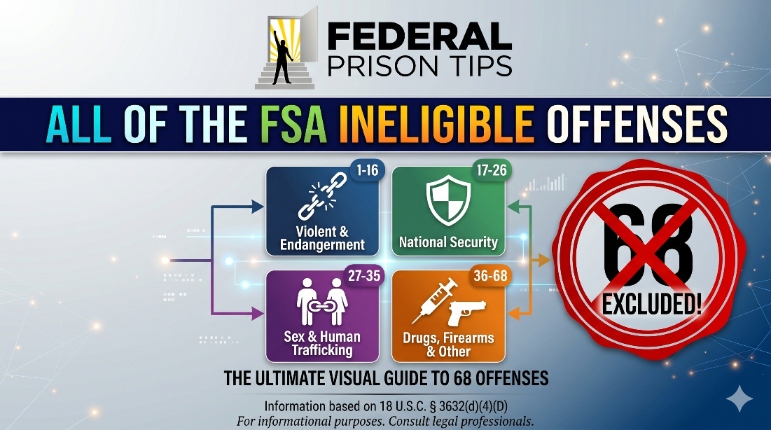
The reality of federal incarceration is that reliable, easy-to-understand information is incredibly hard to come by behind bars. Legal jargon and dense statutory text can be overwhelming, leaving inmates to rely on prison rumors or outdated advice. This is where our newly updated First Step Act Excluded Offenses Infographic becomes a game-changer. By organizing the convoluted legal text into a sleek, color-coded, and highly modern layout, we have stripped away the confusion. Having the your brand’s logo at the top signifies a trusted, structured resource that cuts through the noise, offering immediate clarity to those who need to plan their future.
When you look at the infographic, the first major category highlighted in deep blue covers Violent & Endangerment Crimes. This section spans offenses from the destruction of aircraft and drive-by shootings to bank robbery resulting in death, kidnapping, and murder. For inmates serving time under these statutes, the infographic provides a stark but necessary dose of reality. Knowing exactly where you stand from day one allows an individual to manage their expectations, avoid the heartbreak of calculated time credits that will never be approved by the Bureau of Prisons (BOP), and focus on other legal remedies or institutional goals.
The second core pillar of the visual guide, highlighted in sharp green, details Terrorism & National Security Offenses. This includes highly technical and severe crimes such as biological or chemical weapons possession, treason, espionage, and sabotage of nuclear facilities. While these charges represent a smaller percentage of the general federal prison population, the consequences of a conviction here are absolute regarding the FSA. The infographic makes it undeniably clear that the federal government treats national security threats with zero leniency when it comes to early release incentives.
Moving down the chart, the purple section addresses Sex & Human Trafficking Offenses. Congress drew a very hard line here, excluding female genital mutilation, sexual abuse, the exploitation of children, child pornography, and sex trafficking. For families trying to help a loved one navigate their sentence from the outside, this clear visual separation is incredibly beneficial. It prevents costly mistakes—such as hiring expensive consultants to calculate FSA credits that an inmate technically cannot receive due to a underlying sexual or trafficking offense.
The final, largest section on the infographic—colored in warm orange—tackles Drugs, Firearms, and High-Level Financial Crimes. This section is perhaps the most nuanced and critical for the average federal inmate. While standard drug possession or low-level trafficking can qualify for time credits, the infographic highlights the severe exceptions. Drug offenses resulting in death or bodily injury, specific high-quantity fentanyl trafficking, and crimes involving the use of a firearm during a violent or drug-related offense (such as a 924(c) conviction) will completely lock an inmate out of the FSA credit system.
Furthermore, the infographic goes a step deeper by highlighting the heavily debated “Leadership Role” exclusions (Items 64 through 68). These are crimes where an inmate isn’t disqualified by the statute alone, but rather by a specific judicial finding during sentencing. If the judge determined that an individual acted as an organizer, leader, manager, or supervisor in a major heroin, methamphetamine, or fentanyl conspiracy, they are stripped of their FSA eligibility. Having this listed explicitly helps inmates cross-reference their Pre-Sentence Investigation Report (PSR) and Judgment order to see if these technical enhancements apply to them.
Ultimately, why is this visual breakdown so beneficial to inmates? Because information is power, and clarity prevents despair. In the high-stress environment of a federal facility, false hope is a dangerous thing. When inmates spend months taking classes under the assumption that they are earning a ticket home, only to be told by a case manager that a technicality in their offense makes them ineligible, the psychological toll is devastating. This infographic provides immediate truth, allowing inmates to map out an honest, realistic roadmap for their incarceration.
For those who check the infographic and find their offense is not listed, it provides an incredible burst of motivation to hit the ground running, sign up for every available class, and maximize their time credits. For those whose offenses are listed, it redirects their focus toward other vital avenues, such as seeking a sentence reduction under 18 U.S.C. § 3582 (Compassionate Release), pursuing an appeal, or focusing heavily on institutional programs that offer certificate handbooks and vocational trades to prepare for a successful release, regardless of the timeline. Clear data changes lives, and this visual tool bridges the gap between complex federal law and real-world prison survival.