

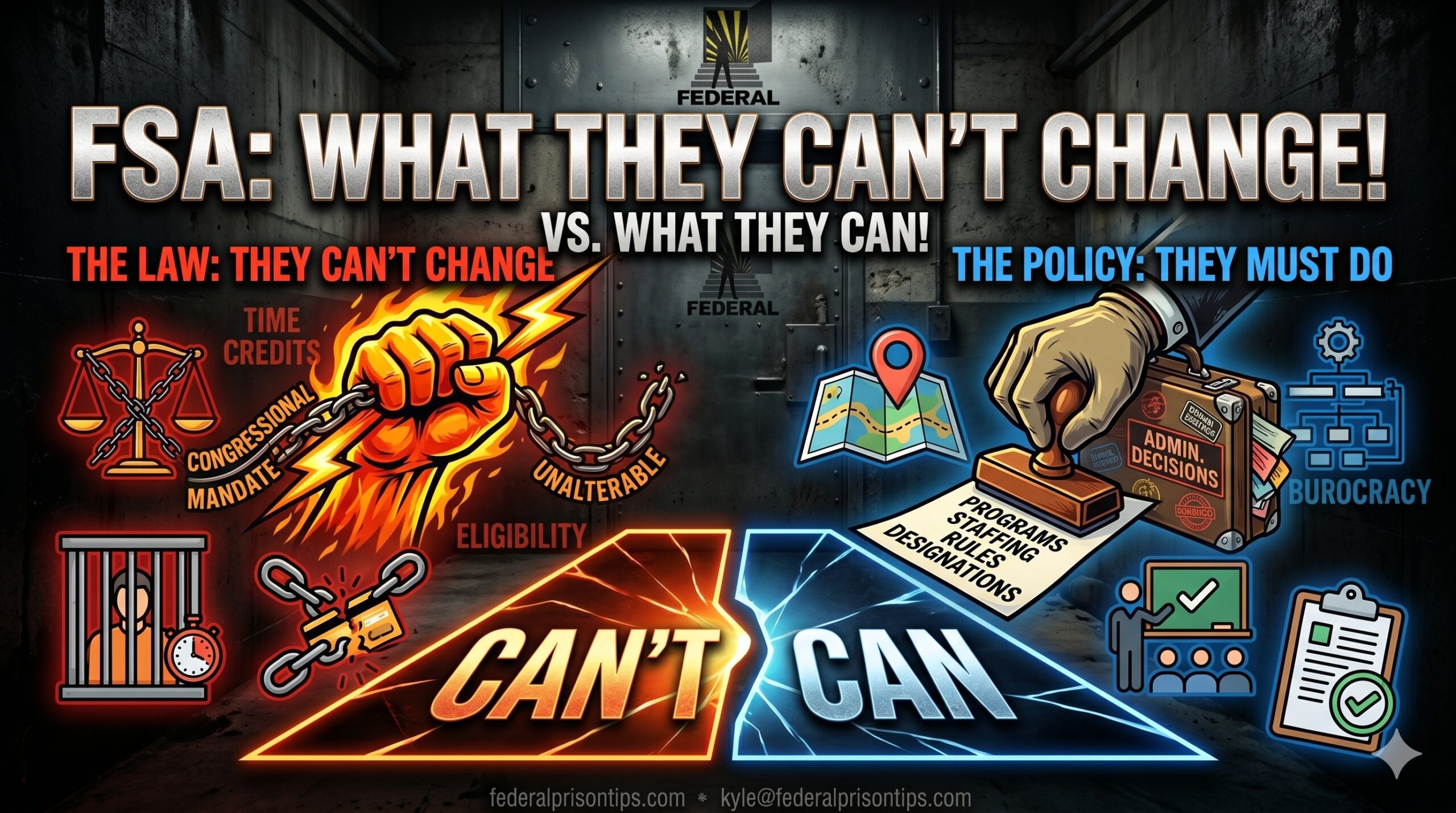
The First Step Act (FSA) Is A Law and Not BOP Policy This Infographic Explains What BOP can and can’t do as far as FSA is Concerned.
The passage of the First Step Act (FSA) marked a seismic shift in the landscape of the federal prison system, introducing unprecedented opportunities for early release and recidivism reduction for thousands of incarcerated individuals. However, for many families and advocates trying to navigate this new terrain, a persistent frustration remains: inconsistencies in how the law is applied and a lack of transparency from the Bureau of Prisons (BOP). It is easy to point fingers at the BOP as the sole source of these challenges, but a closer examination reveals a complex interplay between federal statute and agency policy that is often misunderstood. Successfully advocating for a loved one under the FSA requires understanding precisely where congressional mandates end and BOP discretion begins.

As the infographic in our context demonstrates, the FSA is not a monolithic directive; it is a split-level system. One side of this structure is composed of the FSA Law itself (congressional mandates), which is immutable and sets the fundamental rules. The other side is the BOP Policy (agency discretion), which is the system’s operational layer. The confusion arises because these two layers must constantly interact. The law establishes what must happen, but the BOP creates the internal procedures—the policies—for how it happens. Understanding this division is critical because you cannot demand the BOP change something that is fixed by law, just as you cannot assume a policy applies to all aspects of the FSA.
This foundational distinction is the primary reason for many of the implementation hurdles that cause confusion. For example, while the FSA mandates the creation of the Risk and Needs Assessment System (which resulted in the creation of the PATTERN tool), the BOP has discretion over which specific “Evidence-Based Recidivism Reduction” (EBRR) and “Productive Activities” (PAs) will fulfill the act’s requirement and how many credits each will earn. The law demands programs, but the BOP decides which programs count and how much. This allows for significant operational variation and, consequently, frustration.
One of the most crucial points on the ‘Cannot Do’ side of our infographic is the change to “Good Conduct Time.” This correction from 47 days to 54 days of good time per year of the sentence imposed (not per year served) was applied retroactively, freeing thousands. This was a direct, statutory fix that the BOP had zero power to resist or alter. However, the application of FSA Earned Time Credits—which are separate from Good Conduct Time—is entirely subject to the rules of eligibility. The law defines the categories of offenses that are disqualified from earning these credits (like certain violent, terrorism, or sex offenses), but the BOP has to assess each individual and apply these statutory rules to their specific criminal history. This is another area where policy meets the hard wall of the statute.
The BOP also has zero discretion when it comes to the specific earning rates for FSA credits. The FSA explicitly mandates that eligible individuals earn 10 days of credit for every 30 days of program participation, and those at a “Minimum” or “Low” risk level can earn an additional 5 days (totaling 15 per 30 days). The BOP is statutorily bound by these numbers and cannot reduce them. However, they can create policy around how successful participation is defined, measured, and verified before the credits are awarded. This means a policy can impact access to credits, even if it can’t change the numbers themselves.
Another area where the BOP’s hands are tied is the requirement to conduct risk assessments (using PATTERN). The law requires regular re-assessments at least annually. Policy cannot remove this requirement. But the BOP has significant discretion over the quality and consistency of these assessments. This split is why it is often necessary to advocate for more frequent or accurate assessments at the local facility level, rather than challenging the existence of the PATTERN tool itself on a systemic level. The core issue is implementation policy, not the law that mandates it.
The implementation of the First Step Act is an ongoing process defined by this complex relationship between an immutable law and adaptable agency policy. Recognizing this distinction is the first step to becoming a more effective advocate. When you understand what the BOP is truly incapable of changing, you can shift your strategy to focus on the policy areas where they hold the power: program availability, the accuracy of PATTERN assessments, and the fair application of eligibility rules. If you are struggling to navigate this complex system, we are here to help. For more detailed guides, resources, and individualized support on how these rules specifically impact you or your family member, visit us at federalprisontips.com or email kyle@federalprisontips.com to connect with experts who understand the labyrinth.