

Miles v Bowers Decision Says FSA Credits Start At Sentencing (First Circuit)
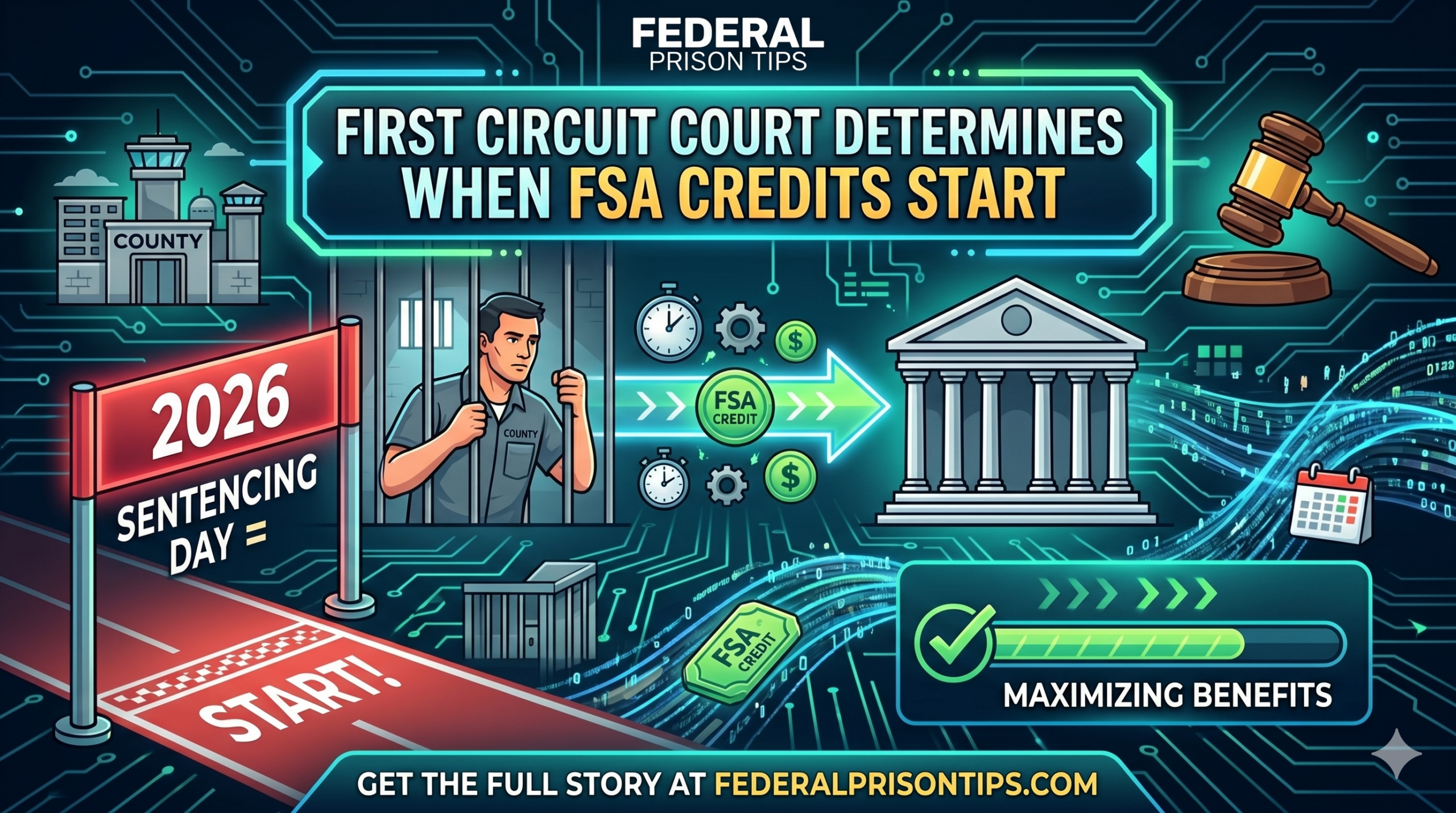
For years, federal inmates have faced a frustrating “administrative waiting room” after their sentencing. Even though a judge has handed down the judgment and the sentence has legally commenced, the Bureau of Prisons (BOP) has historically refused to start the clock on First Step Act (FSA) Time Credits until a prisoner physically arrives at their designated federal facility. This policy often cost inmates weeks or even months of credit while they sat in local county jails awaiting transport. However, a landmark ruling from the First Circuit Court of Appeals in Miles v. Bowers (2026) has finally declared this delay illegal, forcing a major shift in how federal time is calculated.

The core of the dispute rested on a direct conflict between the BOP’s internal regulations and federal law. Under 28 C.F.R. § 523.42(a), the BOP argued that credits could only be earned after “arrival” at a designated facility. Yet, the First Step Act itself—found in 18 U.S.C. § 3632—mandates that eligible prisoners earn credits during their “term of imprisonment.” By looking at the broader legal definition in 18 U.S.C. § 3585(a), the First Circuit noted that a sentence officially “commences” the moment a defendant is received into custody for transportation. The court essentially told the BOP they couldn’t move the “start line” just because their bus was running late.
This decision is the first of its kind at the appellate level to explicitly strike down the BOP’s “arrival” requirement. By invalidating the regulation, the court has opened the door for thousands of inmates across the First Circuit—which includes Maine, Massachusetts, New Hampshire, Puerto Rico, and Rhode Island—to reclaim credit for time spent in local transit. This “gap time” is no longer a total loss; as long as an inmate was eligible for programming, the clock must now start running the moment the gavel hits the desk at sentencing.
While the Miles decision settles the “start date,” the legal battle has now shifted toward the “end date” of these calculations. In a separate but equally significant trend, the Second Circuit recently ruled in Rivera-Perez v. Stover (2026) that these credits cannot be used to shorten a term of supervised release (probation). This creates a critical window of utility: FSA credits are incredibly powerful for moving up your release date or getting you into a halfway house sooner, but they effectively “expire” the moment you walk out the prison gates. You cannot “bank” them to cut down your time on paper once you are back in the community.
This creates a high-stakes scenario for those with “overflow” credits. If an inmate earns the maximum 365 days of early release credit, any additional credits they earn must be applied toward Prerelease Custody (Halfway House or Home Confinement). Unlike early release, there is no statutory cap on how much time can be spent in prerelease custody. Theoretically, an inmate could spend the final years of their sentence at home, provided they have the credits and the BOP has the administrative capacity to place them.
Federal Prison Tips Can Help Your Inmate With Their FSA Credits.
And now through May 3, 2026 all 2241 assistance is 25% off either Shopify or Zelle.
The special is limited to the first 20 customers only!
✓ 10 day turnaround
✓ Federal Prison Tips has helped 521 inmates with FSA/SCA issues!
However, the BOP often utilizes an internal “18-month rule,” where they stop updating credit calculations as an inmate nears release to simplify their paperwork. This is where the logic of Miles v. Bowers becomes a vital tool for advocacy. If the court says the BOP cannot use internal rules to ignore the start of a sentence, it stands to reason they cannot use internal rules to ignore the end of one either. Inmates who are being denied their full prerelease time due to administrative “freezes” now have a much stronger precedent to cite in their Habeas petitions.
As the legal landscape continues to evolve, the First Circuit’s ruling serves as a beacon of fairness in a system often bogged down by bureaucracy. It reinforces the idea that the First Step Act was designed to incentivize rehabilitation from day one—not from “day one at a specific zip code.” For families and inmates navigating the federal system, the message is clear: the start date matters, every day counts, and the law is finally catching up to the reality of the sentence. If your credits don’t reflect your time in transit post-sentencing, it is time to take a closer look at your calculation.
IF YOUR FSA CREDITS ARE WRONG, WE CAN HELP! Contact us now for a review of your time: Kyle@FederalPrisonTips.com | FederalPrisonTips.com/habeas