

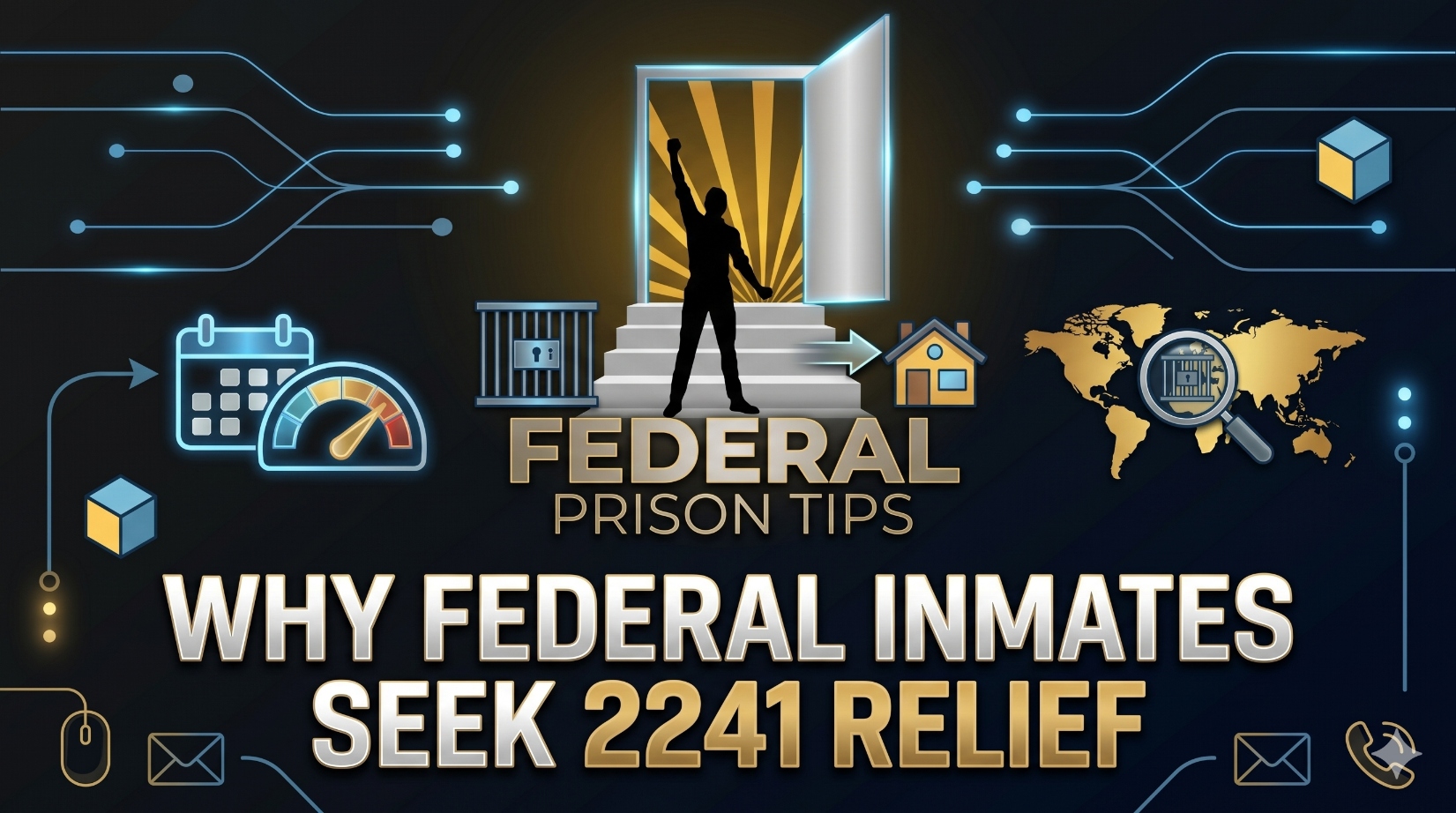
Why Inmates In Federal Prison Seek Relief Under Habeas (2241)
For individuals incarcerated within the Federal Bureau of Prisons (BOP), understanding the legal
avenues for challenging the execution of a sentence is critical. While a 2255 motion is typically
used to challenge the validity of the conviction itself, a petition under 28 U.S.C. § 2241 is the
primary vehicle for addressing how a sentence is being carried out. This includes issues ranging
from the computation of time to the location of confinement. As the landscape of federal sentencing
evolves through legislation like the First Step Act (FSA) and the Second Chance Act (SCA), the
2241 petition has become an indispensable tool for ensuring that inmate rights are upheld and
statutory mandates are followed.
The Impact of the First Step Act (FSA)
The First Step Act introduced a transformative system of Earned Time Credits (ETC) designed to
incentivize recidivism reduction programming. However, the implementation of these credits by the
BOP has often been fraught with delays and calculation errors. Inmates frequently find themselves
eligible for early release or increased halfway house time, yet the credits remain “unapplied” or
wrongly computed. A § 2241 petition allows an inmate to challenge these administrative failures,
forcing the court to intervene when the BOP fails to award credits for eligible Evidence-Based
Recidivism Reduction (EBRR) programs or Productive Activities (PA) as required by federal law.
Beyond simple math errors, legal disputes often arise regarding eligibility for these credits. The
BOP occasionally interprets the FSA in a restrictive manner that excludes certain groups of inmates
or refuses to apply credits retroactively in accordance with the latest judicial interpretations. When
an inmate has exhausted their administrative remedies and the BOP remains firm in a wrongful
denial of credits, the § 2241 petition serves as the formal legal challenge. This ensures that the
legislative intent of the FSA—to reward rehabilitation with earned liberty—is not stifled by
bureaucratic inertia.

Second Chance Act and Reentry Placement
The Second Chance Act (SCA) focuses heavily on the final phase of incarceration, specifically
placement in Residential Reentry Centers (RRC) and Home Confinement. Federal law mandates
that the BOP must, to the extent practicable, ensure that an inmate spends a portion of the final
months of their sentence under conditions that will afford that person a reasonable opportunity to
adjust to and prepare for reentry. When the BOP applies “blanket policies” that limit RRC time to a
standard six months regardless of individual needs, or fails to consider the statutory factors listed in
18 U.S.C. § 3621(b), a § 2241 petition can be used to demand an individualized assessment.
Proximity to Home and Conditions of Confinement
One of the most overlooked provisions of the First Step Act is the requirement for the BOP to
house inmates within 500 driving miles of their primary residence, when practicable. Being placed
more than 500 miles away creates significant hardships, hindering family reunification and making
the transition back into society much more difficult. While the BOP maintains broad authority over
transfers, an inmate can use § 2241 to challenge their location if the BOP has ignored the
“proximity to home” mandate without a valid security or medical justification. This is fundamentally
a challenge to the “execution” of the sentence, as the location of confinement directly impacts the
inmate’s ability to maintain familial bonds.
The effectiveness of the FSA and SCA depends entirely on how the BOP translates these laws into
Program Statements and internal rules. Unfortunately, these internal policies sometimes contradict
the plain language of the statutes or the intent of Congress. When the BOP misinterprets the law to
deny an inmate’s rights—whether it’s a refusal to transfer, a denial of participation in a specific
program, or an inconsistent application of rules between different facilities—a § 2241 petition
provides a check on that power. It moves the dispute from a closed administrative loop into a
federal courtroom where a judge can review the legality of the BOP’s actions.
Ultimately, navigating the complexities of 28 U.S.C. § 2241 requires a precise understanding of
both the law and the internal operations of the Bureau of Prisons. These petitions are time-sensitive
and highly technical, often requiring a clear showing that administrative remedies have been
exhausted. However, for those facing wrongful sentence computation or denied reentry
opportunities, the 2241 remains a powerful shield against administrative overreach. Ensuring that
you are closer to home, receiving your earned credits, and being given a fair chance at reentry is
not just a preference—it is a statutory right that deserves a robust defense.
LEt Federal PRison Tips Help You With A 2241
2241 Assistance From Federal Prison Tips Works
Federal Prison Tips has helped hundreds of inmates with FSA, SCA, 500 mile issues and appealing shots (incident reports) with 2241s. Let us help you today Find out more here
512+
Inmates helped
Save
$200 with zelle
