

Collins Ruling Says Judges And Others Can’t Make You Wait To Ask For Early Termination of Supervision They Must Go By Statute
So many times former inmates in federal prison, who understand the statute for early termination of supervison, go to their probation officer or even before their judge and they’re told to wait until they are halfway done, that’s not the statute, and now a sixth circuit ruling has said judges can no longer arbitrarily do that.
A Landmark Ruling Ends Secret Rules and ‘Hidden Goalposts’ for Early Supervised Release
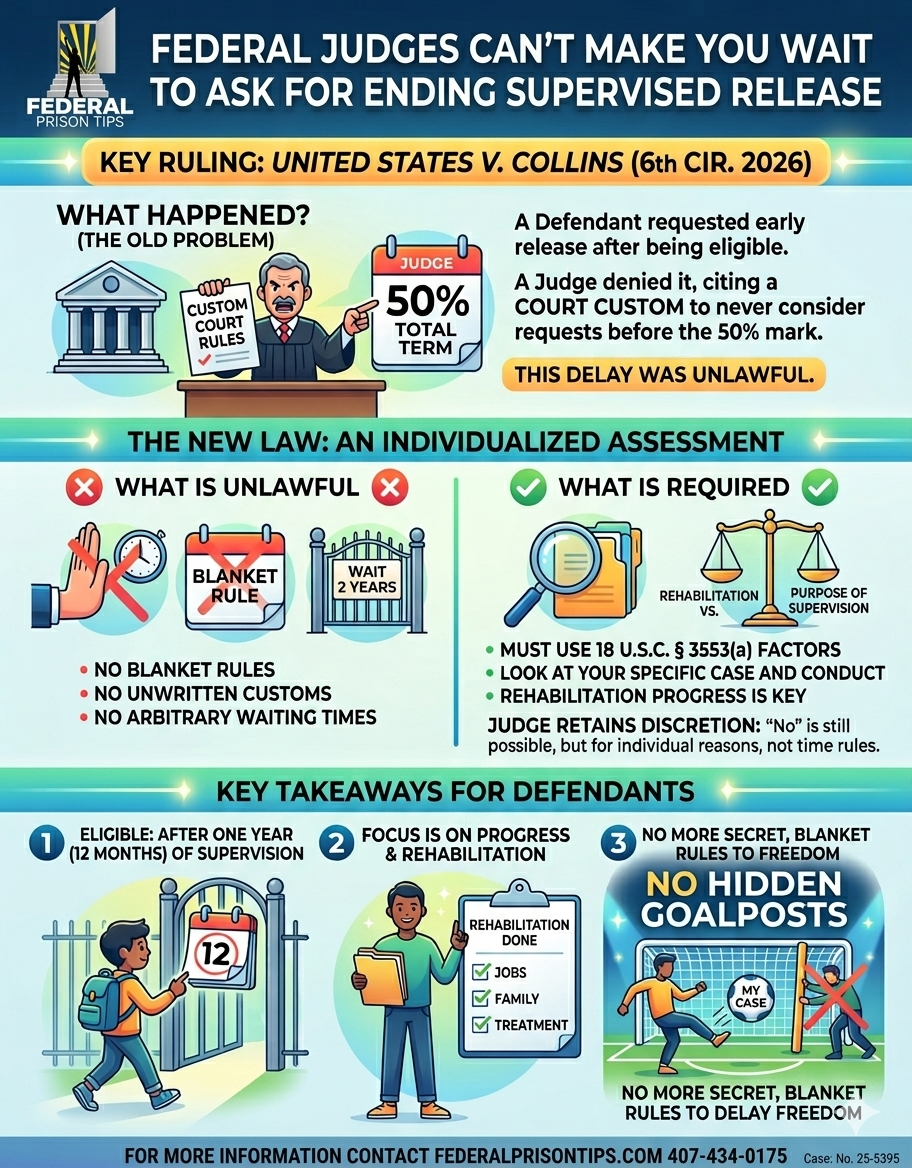
For many individuals on federal supervised release, navigating the path to freedom has long felt like a game where the rules are unwritten and the referee keeps changing the goalposts. A common frustration has been confronting arbitrary waiting times imposed not by law, but by unwritten court customs. A landmark new ruling from the 6th Circuit, United States v. Collins (2026), has definitively changed this landscape, declaring that federal judges can no longer make you wait unnecessarily to even request the end of your supervised release.
Previously, defendants who had served their time and become statutorily eligible for early termination faced an unlawful hurdle. Many courts relied on “custom court rules” to create arbitrary waiting periods. A typical scenario, illustrated in the Collins case, involved a defendant requesting early release, only for a judge to deny it on the grounds of a custom to “never consider” such requests until the defendant had served at least 50% of their total term. This practice, the ruling clarifies, was a systematic and unlawful delay.
The United States v. Collins case is a significant victory for defendants, establishing a key legal principle. The ruling confirms that judges cannot use secret, unwritten customs to block or delay a defendant’s right to ask for consideration. It establishes that arbitrary time-based barriers, like the 50% rule, are unlawful. The core mandate of the ruling is clear: the law requires an “individualized assessment” of each defendant, not the application of a one-size-fits-all blanket rule.
The New Law: Moving from Blanket Rules to Individualized Assessments
Under this new precedent, what is “required” from judges has completely shifted. Blanket rules, unwritten customs, and arbitrary waiting times are now firmly in the category of what is “unlawful.” To determine if early release is appropriate, judges must move away from generalities and look at your specific case and conduct. Instead of a calendar, judges are required to apply the critical 18 U.S.C. § 3553(a) factors to guide their assessment.
At the heart of this individualized assessment is the focus on “rehabilitation progress.” The core comparison a judge must make is “Rehabilitation vs. The Purpose of Supervision.” Has the defendant demonstrated a successful return to society? While the judge still retains discretion and a simple “No” is still a possible outcome, any such denial must now be based on specific, individualized reasons related to the defendant’s conduct and needs, not a predetermined time-based policy.
Key Takeaways for Defendants Seeking Early Release
This ruling has three profound takeaways for anyone currently on supervised release. First, you are generally eligible to apply after serving one year (12 months) of supervision. Second, your preparation should focus entirely on demonstrating your tangible progress and rehabilitation. This includes having stable employment (JOBS), a strong family support network (FAMILY), and successfully completing any required treatment programs (TREATMENT). Finally, you should feel empowered knowing there are “no more hidden goalposts” and “no more secret, blanket rules to delay freedom.”
Federal Prison Tips Early Termination Assistance Special
If you are currently on supervised release, you no longer have to wait for an invisible clock to run down. Your path to freedom is now determined by your personal record and rehabilitation. For a comprehensive legal review of your situation and a specific case strategy based on this historic 6th Circuit ruling, we can help. Federal Prison Tips is running a special on early termination of supervision assistance this weekend only April 10th through April 12th for just $700 paid by zelle. Our zelle is 754-330-0007 and will come up “Federal Prison Tips LLC”. Once you’ve made the payment please complete this form and if you do it this weekend we will have you ready by Friday April 17, 2026. Got questions? Email info@federalprisontips.com or call 407-434-0175.
Feel free to download this handy infographic right now:
